 |
Motor de Búsqueda de Datasheet de Componentes Electrónicos |
|
|
Motor de Búsqueda de Datasheet de Componentes Electrónicos |
|
The question interval is too short.
Please try again in a few seconds.

Hello, Please ask a question about LTC2753 Datasheet
# Example questions:
➢ What is the typical integral nonlinearity (inl) for a 0v to 10v output range, as shown in the typical performance characteristics graphs?
➢ The datasheet mentions a 'major carry transition'. what voltage range is this measured across, and what is it related to?
➢ What component, when used with the ltc2757 and set to 27pf, allows for achieving a ±0.0004% settling time of 8μs?
| Part No. | LTC2753 |
| Manufacturer | LINER |
| Size | 264 Kbytes |
| Pages | 20 pages |
| Description | 18-Bit SoftSpan IOUT DAC with Parallel I/O |

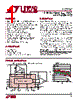
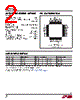
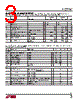
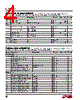
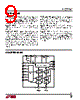


1. Overview & Functionality:
️· The LTC2757 is a precision, low-noise, 18-bit Digital-to-Analog Converter (DAC).
️· It employs a proprietary "SoftSpan" switching architecture.
️· It has buffered outputs (I OUT1 and I OUT2).
️· The architecture aims for consistent resistance for all output ranges.
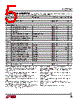
2. Key Specifications (Typical, at 25°C unless noted): (These are only a selection, the full spec sheet would contain many more parameters)
️· Resolution: 18 bits
️· Settling Time: 1.8 μs (for ±0.0004% settling) - *achieved with specific external components (LT1468 and capacitor)*
️· INL (Integral Nonlinearity): Ranges from around -1.0 to +1.0 LSB, depending on the output range.
️· DNL (Differential Nonlinearity): Generally around ±0.5 LSB.
️· Gain Error: +/- 10 ppm/°C
️· Reference Input Range: Varies depending on the output range
️· Power Supply Voltages: Varies, typically dual supply.
️· Output Voltage Range: Dependent on the configuration (e.g., 0V to 5V, 0V to 10V, -10V to +10V, etc.).
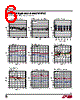
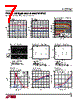
3. Typical Performance Characteristics (Important for understanding behavior):
️· INL vs. Output Range: INL is shown for various output ranges (0V-5V, -2.5V to 2.5V, 0V to 10V, -10V to 10V).
️· INL vs. Temperature: Shows the impact of temperature on integral nonlinearity.
️· DNL vs. Temperature: Shows the impact of temperature on differential nonlinearity.
️· Gain Error vs. Temperature: Shows how gain error changes with temperature.
️· Bipolar Zero Error: Shows how bipolar zero error changes with V(R IN) .
️· INL vs. Reference Voltage: Shows the impact of reference voltage on INL.
️· DNL vs. Reference Voltage: Shows the impact of reference voltage on DNL.
4. Notes and Important Considerations:
️· SoftSpan Architecture: The switching architecture helps maintain consistent resistance across all output ranges.
️· External Components: Settling time is significantly impacted by external components, particularly the feedback capacitor (C FEEDBACK). The example given uses an LT1468 amplifier and C FEEDBACK = 27pF.
️· Temperature Sensitivity: INL and DNL are temperature-dependent. Gain Error is also temp dependent.
️· Reference Voltage: The performance (INL, DNL) is affected by the reference voltage.
️· Design Considerations: Parallel combination of the resistances from REF to I OUT1 and from REF to I OUT2 is a factor in design.
️· Production Testing: Some parameters are guaranteed by design, not by production test.
5. Key Takeaways & Application Focus:
️· High Precision: The LTC2757 is designed for applications requiring high resolution and accuracy.
️· Versatile Output Ranges: Supports a wide variety of output voltage ranges, providing flexibility for different applications.
️· Temperature Stability: While it has some temperature dependence, careful design and component selection can mitigate these effects.
️· Applications: Suitable for precision instrumentation, automated test equipment (ATE), data acquisition systems, and other applications needing accurate voltage control.
️· Careful Design: Optimizing the external components (particularly amplifiers and capacitors) is crucial for achieving the desired performance, especially settling time.
1. Overview & Functionality:
️· The LTC2757 is a precision, low-noise, 18-bit Digital-to-Analog Converter (DAC).
️· It employs a proprietary "SoftSpan" switching architecture.
️· It has buffered outputs (I OUT1 and I OUT2).
️· The architecture aims for consistent resistance for all output ranges.
2. Key Specifications (Typical, at 25°C unless noted): (These are only a selection, the full spec sheet would contain many more parameters)
️· Resolution: 18 bits
️· Settling Time: 1.8 μs (for ±0.0004% settling) - *achieved with specific external components (LT1468 and capacitor)*
️· INL (Integral Nonlinearity): Ranges from around -1.0 to +1.0 LSB, depending on the output range.
️· DNL (Differential Nonlinearity): Generally around ±0.5 LSB.
️· Gain Error: +/- 10 ppm/°C
️· Reference Input Range: Varies depending on the output range
️· Power Supply Voltages: Varies, typically dual supply.
️· Output Voltage Range: Dependent on the configuration (e.g., 0V to 5V, 0V to 10V, -10V to +10V, etc.).
3. Typical Performance Characteristics (Important for understanding behavior):
️· INL vs. Output Range: INL is shown for various output ranges (0V-5V, -2.5V to 2.5V, 0V to 10V, -10V to 10V).
️· INL vs. Temperature: Shows the impact of temperature on integral nonlinearity.
️· DNL vs. Temperature: Shows the impact of temperature on differential nonlinearity.
️· Gain Error vs. Temperature: Shows how gain error changes with temperature.
️· Bipolar Zero Error: Shows how bipolar zero error changes with V(R IN) .
️· INL vs. Reference Voltage: Shows the impact of reference voltage on INL.
️· DNL vs. Reference Voltage: Shows the impact of reference voltage on DNL.
4. Notes and Important Considerations:
️· SoftSpan Architecture: The switching architecture helps maintain consistent resistance across all output ranges.
️· External Components: Settling time is significantly impacted by external components, particularly the feedback capacitor (C FEEDBACK). The example given uses an LT1468 amplifier and C FEEDBACK = 27pF.
️· Temperature Sensitivity: INL and DNL are temperature-dependent. Gain Error is also temp dependent.
️· Reference Voltage: The performance (INL, DNL) is affected by the reference voltage.
️· Design Considerations: Parallel combination of the resistances from REF to I OUT1 and from REF to I OUT2 is a factor in design.
️· Production Testing: Some parameters are guaranteed by design, not by production test.
5. Key Takeaways & Application Focus:
️· High Precision: The LTC2757 is designed for applications requiring high resolution and accuracy.
️· Versatile Output Ranges: Supports a wide variety of output voltage ranges, providing flexibility for different applications.
️· Temperature Stability: While it has some temperature dependence, careful design and component selection can mitigate these effects.
️· Applications: Suitable for precision instrumentation, automated test equipment (ATE), data acquisition systems, and other applications needing accurate voltage control.
️· Careful Design: Optimizing the external components (particularly amplifiers and capacitors) is crucial for achieving the desired performance, especially settling time.
| Part No. | LTC2753 |
| Manufacturer | LINER |
| Size | 264 Kbytes |
| Pages | 20 pages |
| Description | 18-Bit SoftSpan IOUT DAC with Parallel I/O |
| ¿ALLDATASHEET es útil para Ud.? [ DONATE ] |
Todo acerca de Alldatasheet | Publicidad | Contáctenos | Política de Privacidad | Enlace a la hoja de datos | Intercambio de Enlaces | Lista de Fabricantes All Rights Reserved©Alldatasheet.com |
| Russian : Alldatasheetru.com | Korean : Alldatasheet.co.kr | Spanish : Alldatasheet.es | French : Alldatasheet.fr | Italian : Alldatasheetit.com Portuguese : Alldatasheetpt.com | Polish : Alldatasheet.pl | Vietnamese : Alldatasheet.vn Indian : Alldatasheet.in | Mexican : Alldatasheet.com.mx | British : Alldatasheet.co.uk | New Zealand : Alldatasheet.co.nz |
|
Family Site : ic2ic.com |
icmetro.com |
 Mexican ▼
  English
 Chinese
 German
 Japanese
 Russian
 Korean
 Spanish
 French
 Italian
 Portuguese
 Polish
 Vietnamese
 Indian
 British
 New Zealand