 |
Motor de Búsqueda de Datasheet de Componentes Electrónicos |
|
|
Motor de Búsqueda de Datasheet de Componentes Electrónicos |
|
The question interval is too short.
Please try again in a few seconds.

Hello, Please ask a question about PCD3755AP Datasheet
# Example questions:
➢ Explain the key difference between writing to ram and writing to eeprom, as described in the document. what special consideration is needed when clearing a bit in eeprom?
➢ How does the organization of the eeprom into pages (specifically, the 32 four-byte pages) contribute to more efficient write and erase operations?
➢ What are the primary uses of the eeprom in the pcd3755a, pcd3755e, and pcd3755f microcontrollers?
| Part No. | PCD3755AP |
| Manufacturer | PHILIPS |
| Size | 200 Kbytes |
| Pages | 32 pages |
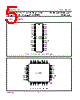
| Description | 8-bit microcontrollers with DTMF generator, 8 kbytes OTP and 128 bytes EEPROM |





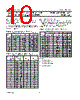


Okay, here's a summary of the provided text, focusing on the key information regarding the PCD3755A, PCD3755E, and PCD3755F microcontrollers:
Core Functionality & Features:
️· DTMF Generation: These microcontrollers are designed to generate Dual-Tone Multi-Frequency (DTMF) signals, commonly used in telephone systems.
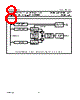
️· EEPROM: 128 bytes of Electrically Erasable Programmable Read-Only Memory (EEPROM) is included for non-volatile data storage (redial numbers, customization, trimming parameters, etc.). It operates with an erase-and-write cycle (cannot directly clear a bit - performs a logical OR). Write/Erase operations are slow (5ms) but optimized with page access (4 bytes at a time).
️· Timer 2: A derivative 8-bit down-counter is provided for timing tasks related to EEPROM operations and general real-time applications (signal duration, pulse widths).
️· Memory Organization: EEPROM is structured into 32 four-byte pages for efficient access. Auto-incrementing addresses are available for sequential access.
Specific Capabilities (based on tables):
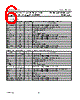
️· Frequency Generation: The microcontroller can generate various frequencies for DTMF tones, musical scales, and even specific notes on a musical scale. Tables provide the hex values to set in the HGF register to achieve these frequencies.
️· Musical Scale: The device can generate two octaves of a musical scale.
️· Standard Support: It supports several telecom standards (V.21, Bell 103, Bell 202, V.23).
Key Registers/Concepts:
️· HGF Register: Used to set the frequency for various tones and scales.
️· EEPROM Address Register: Provides auto-incrementing for efficient memory access.
️· Timer 2: Used for timing EEPROM operations and general real-time tasks.
In essence, these microcontrollers are tailored for telecom applications and embedded systems requiring non-volatile data storage, frequency generation (especially DTMF), and real-time timing control.
Core Functionality & Features:
️· DTMF Generation: These microcontrollers are designed to generate Dual-Tone Multi-Frequency (DTMF) signals, commonly used in telephone systems.
️· EEPROM: 128 bytes of Electrically Erasable Programmable Read-Only Memory (EEPROM) is included for non-volatile data storage (redial numbers, customization, trimming parameters, etc.). It operates with an erase-and-write cycle (cannot directly clear a bit - performs a logical OR). Write/Erase operations are slow (5ms) but optimized with page access (4 bytes at a time).
️· Timer 2: A derivative 8-bit down-counter is provided for timing tasks related to EEPROM operations and general real-time applications (signal duration, pulse widths).
️· Memory Organization: EEPROM is structured into 32 four-byte pages for efficient access. Auto-incrementing addresses are available for sequential access.
Specific Capabilities (based on tables):
️· Frequency Generation: The microcontroller can generate various frequencies for DTMF tones, musical scales, and even specific notes on a musical scale. Tables provide the hex values to set in the HGF register to achieve these frequencies.
️· Musical Scale: The device can generate two octaves of a musical scale.
️· Standard Support: It supports several telecom standards (V.21, Bell 103, Bell 202, V.23).
Key Registers/Concepts:
️· HGF Register: Used to set the frequency for various tones and scales.
️· EEPROM Address Register: Provides auto-incrementing for efficient memory access.
️· Timer 2: Used for timing EEPROM operations and general real-time tasks.
In essence, these microcontrollers are tailored for telecom applications and embedded systems requiring non-volatile data storage, frequency generation (especially DTMF), and real-time timing control.
| Part No. | PCD3755AP |
| Manufacturer | PHILIPS |
| Size | 200 Kbytes |
| Pages | 32 pages |
| Description | 8-bit microcontrollers with DTMF generator, 8 kbytes OTP and 128 bytes EEPROM |
| ¿ALLDATASHEET es útil para Ud.? [ DONATE ] |
Todo acerca de Alldatasheet | Publicidad | Contáctenos | Política de Privacidad | Enlace a la hoja de datos | Intercambio de Enlaces | Lista de Fabricantes All Rights Reserved©Alldatasheet.com |
| Russian : Alldatasheetru.com | Korean : Alldatasheet.co.kr | Spanish : Alldatasheet.es | French : Alldatasheet.fr | Italian : Alldatasheetit.com Portuguese : Alldatasheetpt.com | Polish : Alldatasheet.pl | Vietnamese : Alldatasheet.vn Indian : Alldatasheet.in | Mexican : Alldatasheet.com.mx | British : Alldatasheet.co.uk | New Zealand : Alldatasheet.co.nz |
|
Family Site : ic2ic.com |
icmetro.com |
 Mexican ▼
  English
 Chinese
 German
 Japanese
 Russian
 Korean
 Spanish
 French
 Italian
 Portuguese
 Polish
 Vietnamese
 Indian
 British
 New Zealand