 |
Motor de Búsqueda de Datasheet de Componentes Electrónicos |
|
|
Motor de Búsqueda de Datasheet de Componentes Electrónicos |
|
The question interval is too short.
Please try again in a few seconds.

Hello, Please ask a question about LTM4650 Datasheet
# Example questions:
➢ What parameters are used to validate the typical performance characteristics, and what note signifies information validated through bench measurements?
➢ What is the significance of the note regarding ate testing and what does it imply about the data provided in the document?
➢ What is the recommended approach to minimize internal module temperature rise, and what alternative should be considered if vout is less than 8v?
| Part No. | LTM4650 |
| Manufacturer | AD |
| Size | 2Mb |
| Pages | 28 pages |
| Description | 60V, 300W Hybrid Step-Down Module Bus Converter |


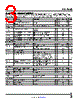

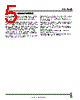
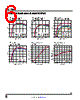
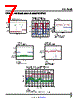

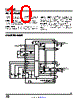


1. General Information & Product Designation:
️· Product: LTM4660
️· Type: Power Module
️· Revision: Datasheet excerpts, Rev 0
2. Key Electrical Characteristics (from Tables):
️· Input Voltage (V<sub>IN</sub>): Not explicitly stated as a single value, but applications mentioned voltages of 48V and 54V.
️· Output Voltage (V<sub>OUT</sub>): Values mentioned: 12V, 5V.
️· Switching Frequency (f<sub>SW</sub>): Shown in graphs/tables, variable and tunable via an external control pin.
️· Oscillator Frequency: Also variable and tunable.
️· Feedback Resistor: An internal 60.4kΩ resistor contributes to the total output voltage error.
️· Frequency Pin Voltage: A table showing variable frequency control
3. Operating Conditions & Ratings:
️· Internal Operating Temperature Range:
- -40°C to 125°C (assured by design)
- A range with guaranteed specifications
️· Maximum Ambient Temperature: Determined by specific operating conditions, board layout, package thermal resistance, and other factors.
️· External Supply Recommendation: If V<sub>OUT</sub> < 8V, an auxiliary supply for EXTV<sub>CC</sub> is strongly recommended. If 8V <= V<sub>OUT</sub> <= 8V tie V<sub>OUT</sub> to EXTV<sub>CC</sub>.
4. Thermal Considerations:
️· θ<sub>JA</sub>: A thermal resistance value (obtained from demo board DC2879A - see link in the text: [https://www.analog.com/DC2879A?doc=LTM4660.pdf](https://www.analog.com/DC2879A?doc=LTM4660.pdf)). *Important: This is specific to that demo board and may not be representative of other configurations.*
️· Dynamic Supply Current: Higher than static due to gate charge being delivered at the switching frequency (especially in forced continuous mode).
5. Notes & Cautions (from Footnotes):
️· Note 1: Total DC output voltage error includes line and load regulation *plus* the 60.4kΩ feedback resistor tolerance.
️· Note 2: Dynamic supply current is higher. Refer to the Applications Information section for details.
️· Note 3: Output current derating curves are available in the Applications Information section.
️· Note 10: See the demo board DC2879A for θ<sub>JA</sub> value (mentioned above).
6. Important Links & References:
️· Demo Board: DC2879A – Thermal Considerations ([https://www.analog.com/DC2879A?doc=LTM4660.pdf](https://www.analog.com/DC2879A?doc=LTM4660.pdf))
Key Takeaways & Potential Missing Information:
️· Fragmentation: This is a partial datasheet. Critical sections like typical application circuits, package information, and a full list of electrical characteristics are likely missing.
️· Context is Crucial: The thermal data (θ<sub>JA</sub>) is specific to the demo board and may not apply to all applications.
️· Application-Specific: This module is designed for specific applications that require the voltages and characteristics outlined.
️· External Control: The module's switching frequency and potentially other characteristics are controlled by external pins.
1. General Information & Product Designation:
️· Product: LTM4660
️· Type: Power Module
️· Revision: Datasheet excerpts, Rev 0
2. Key Electrical Characteristics (from Tables):
️· Input Voltage (V<sub>IN</sub>): Not explicitly stated as a single value, but applications mentioned voltages of 48V and 54V.
️· Output Voltage (V<sub>OUT</sub>): Values mentioned: 12V, 5V.
️· Switching Frequency (f<sub>SW</sub>): Shown in graphs/tables, variable and tunable via an external control pin.
️· Oscillator Frequency: Also variable and tunable.
️· Feedback Resistor: An internal 60.4kΩ resistor contributes to the total output voltage error.
️· Frequency Pin Voltage: A table showing variable frequency control
3. Operating Conditions & Ratings:
️· Internal Operating Temperature Range:
- -40°C to 125°C (assured by design)
- A range with guaranteed specifications
️· Maximum Ambient Temperature: Determined by specific operating conditions, board layout, package thermal resistance, and other factors.
️· External Supply Recommendation: If V<sub>OUT</sub> < 8V, an auxiliary supply for EXTV<sub>CC</sub> is strongly recommended. If 8V <= V<sub>OUT</sub> <= 8V tie V<sub>OUT</sub> to EXTV<sub>CC</sub>.
4. Thermal Considerations:
️· θ<sub>JA</sub>: A thermal resistance value (obtained from demo board DC2879A - see link in the text: [https://www.analog.com/DC2879A?doc=LTM4660.pdf](https://www.analog.com/DC2879A?doc=LTM4660.pdf)). *Important: This is specific to that demo board and may not be representative of other configurations.*
️· Dynamic Supply Current: Higher than static due to gate charge being delivered at the switching frequency (especially in forced continuous mode).
5. Notes & Cautions (from Footnotes):
️· Note 1: Total DC output voltage error includes line and load regulation *plus* the 60.4kΩ feedback resistor tolerance.
️· Note 2: Dynamic supply current is higher. Refer to the Applications Information section for details.
️· Note 3: Output current derating curves are available in the Applications Information section.
️· Note 10: See the demo board DC2879A for θ<sub>JA</sub> value (mentioned above).
6. Important Links & References:
️· Demo Board: DC2879A – Thermal Considerations ([https://www.analog.com/DC2879A?doc=LTM4660.pdf](https://www.analog.com/DC2879A?doc=LTM4660.pdf))
Key Takeaways & Potential Missing Information:
️· Fragmentation: This is a partial datasheet. Critical sections like typical application circuits, package information, and a full list of electrical characteristics are likely missing.
️· Context is Crucial: The thermal data (θ<sub>JA</sub>) is specific to the demo board and may not apply to all applications.
️· Application-Specific: This module is designed for specific applications that require the voltages and characteristics outlined.
️· External Control: The module's switching frequency and potentially other characteristics are controlled by external pins.
| Part No. | LTM4650 |
| Manufacturer | AD |
| Size | 2Mb |
| Pages | 28 pages |
| Description | 60V, 300W Hybrid Step-Down Module Bus Converter |
| ¿ALLDATASHEET es útil para Ud.? [ DONATE ] |
Todo acerca de Alldatasheet | Publicidad | Contáctenos | Política de Privacidad | Enlace a la hoja de datos | Intercambio de Enlaces | Lista de Fabricantes All Rights Reserved©Alldatasheet.com |
| Russian : Alldatasheetru.com | Korean : Alldatasheet.co.kr | Spanish : Alldatasheet.es | French : Alldatasheet.fr | Italian : Alldatasheetit.com Portuguese : Alldatasheetpt.com | Polish : Alldatasheet.pl | Vietnamese : Alldatasheet.vn Indian : Alldatasheet.in | Mexican : Alldatasheet.com.mx | British : Alldatasheet.co.uk | New Zealand : Alldatasheet.co.nz |
|
Family Site : ic2ic.com |
icmetro.com |
 Mexican ▼
  English
 Chinese
 German
 Japanese
 Russian
 Korean
 Spanish
 French
 Italian
 Portuguese
 Polish
 Vietnamese
 Indian
 British
 New Zealand