 |
Motor de Búsqueda de Datasheet de Componentes Electrónicos |
|
|
Motor de Búsqueda de Datasheet de Componentes Electrónicos |
|
The question interval is too short.
Please try again in a few seconds.

Hello, Please ask a question about AD7011 Datasheet
# Example questions:
➢ What is the primary function of the π/4 dqpsk modulator within the ad7011, and how does it generate the i and q data?
➢ How does the ad7011 handle envelope shaping at the beginning and end of a transmit burst, and what signal controls this process?
➢ Explain the purpose of the transmit calibration routine and what signal indicates its completion.
| Part No. | AD7011 |
| Manufacturer | AD |
| Size | 389 Kbytes |
| Pages | 12 pages |
| Description | CMOS, ADC p/4 DQPSK Baseband Transmit Port |







1. Overall Function & Purpose
️· The AD711's transmit section is designed to generate π/4 DQPSK (Differential Quadrature Phase Shift Keying) waveforms, adhering to TIA specifications for cellular transmission.
️· It also includes an "analog mode" allowing for emulation of analog cellular systems – essentially, a direct path to the DACs bypassing the DQPSK modulator.
2. π/4 DQPSK Modulator - Core Operation
️· Digital Encoding: Serial transmit data (TxDATA) is converted into 2-bit symbols (Xk, Yk). A *differential phase encoder* then generates I and Q impulses (Ik, Qk) based on these symbols. This utilizes phase changes rather than absolute phase values.
- Formula for I & Q: `I_k = COS( φ_(k-1) + ∆φ_k )` and `Q_k = SIN( φ_(k-1) + ∆φ_k )`
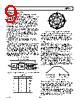
️· Constellation Diagram: The eight possible states of the I/Q data are defined by the constellation diagram (Figure 2) – representing phase shifts.
️· Root-Raised Cosine Filters: The I and Q impulses are passed through FIR root-raised cosine filters (with α = 0.35). These filters shape the data and reduce distortion; they have an impulse response of ±4 symbols.
3. Transmit Calibration
️· Self-Calibration Routine: Upon exiting sleep mode (POWER high), the transmit section performs a self-calibration to eliminate offsets between ITx and ITx and between QTx and QTx.
️· READY Signal: The READY signal goes high when self-calibration completes. BIN (Burst In) must be high *after* READY is high to start transmission.
4. Ramp-Up/Down Envelope Logic
️· Purpose: Provides power shaping at the beginning and end of a transmission burst.
️· Ramp-Up: When BIN goes high:
- The modulator is reset to all zeros.
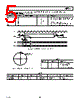
- The first three symbols transmitted are all zeros, causing the ramp-up envelope to go from zero to full scale.
- The next symbol ([I1, Q1]) represents the first two data bits clocked in *after* BIN went high.
️· Ramp-Down: When BIN goes low:
- The Nth symbol is the last active symbol.
- Four additional symbols ([XN+5 to XN+8]) are latched to complete the ramp-down process, given the 4-symbol impulse response of the filters.
5. Key Technical Details & Signals
️· π/4 DQPSK: Differential Quadrature Phase Shift Keying – a modulation scheme.
️· TxDATA: Serial transmit data input.
️· Xk, Yk: 2-bit symbols.
️· Ik, Qk: I and Q impulses.
️· POWER: Control signal for sleep/wake.
️· READY: Indicates completion of self-calibration.
️· BIN: Initiates transmit burst.
️· α = 0.35: Parameter defining the shape of the root-raised cosine filters.
1. Overall Function & Purpose
️· The AD711's transmit section is designed to generate π/4 DQPSK (Differential Quadrature Phase Shift Keying) waveforms, adhering to TIA specifications for cellular transmission.
️· It also includes an "analog mode" allowing for emulation of analog cellular systems – essentially, a direct path to the DACs bypassing the DQPSK modulator.
2. π/4 DQPSK Modulator - Core Operation
️· Digital Encoding: Serial transmit data (TxDATA) is converted into 2-bit symbols (Xk, Yk). A *differential phase encoder* then generates I and Q impulses (Ik, Qk) based on these symbols. This utilizes phase changes rather than absolute phase values.
- Formula for I & Q: `I_k = COS( φ_(k-1) + ∆φ_k )` and `Q_k = SIN( φ_(k-1) + ∆φ_k )`
️· Constellation Diagram: The eight possible states of the I/Q data are defined by the constellation diagram (Figure 2) – representing phase shifts.
️· Root-Raised Cosine Filters: The I and Q impulses are passed through FIR root-raised cosine filters (with α = 0.35). These filters shape the data and reduce distortion; they have an impulse response of ±4 symbols.
3. Transmit Calibration
️· Self-Calibration Routine: Upon exiting sleep mode (POWER high), the transmit section performs a self-calibration to eliminate offsets between ITx and ITx and between QTx and QTx.
️· READY Signal: The READY signal goes high when self-calibration completes. BIN (Burst In) must be high *after* READY is high to start transmission.
4. Ramp-Up/Down Envelope Logic
️· Purpose: Provides power shaping at the beginning and end of a transmission burst.
️· Ramp-Up: When BIN goes high:
- The modulator is reset to all zeros.
- The first three symbols transmitted are all zeros, causing the ramp-up envelope to go from zero to full scale.
- The next symbol ([I1, Q1]) represents the first two data bits clocked in *after* BIN went high.
️· Ramp-Down: When BIN goes low:
- The Nth symbol is the last active symbol.
- Four additional symbols ([XN+5 to XN+8]) are latched to complete the ramp-down process, given the 4-symbol impulse response of the filters.
5. Key Technical Details & Signals
️· π/4 DQPSK: Differential Quadrature Phase Shift Keying – a modulation scheme.
️· TxDATA: Serial transmit data input.
️· Xk, Yk: 2-bit symbols.
️· Ik, Qk: I and Q impulses.
️· POWER: Control signal for sleep/wake.
️· READY: Indicates completion of self-calibration.
️· BIN: Initiates transmit burst.
️· α = 0.35: Parameter defining the shape of the root-raised cosine filters.
| Part No. | AD7011 |
| Manufacturer | AD |
| Size | 389 Kbytes |
| Pages | 12 pages |
| Description | CMOS, ADC p/4 DQPSK Baseband Transmit Port |
| ¿ALLDATASHEET es útil para Ud.? [ DONATE ] |
Todo acerca de Alldatasheet | Publicidad | Contáctenos | Política de Privacidad | Enlace a la hoja de datos | Intercambio de Enlaces | Lista de Fabricantes All Rights Reserved©Alldatasheet.com |
| Russian : Alldatasheetru.com | Korean : Alldatasheet.co.kr | Spanish : Alldatasheet.es | French : Alldatasheet.fr | Italian : Alldatasheetit.com Portuguese : Alldatasheetpt.com | Polish : Alldatasheet.pl | Vietnamese : Alldatasheet.vn Indian : Alldatasheet.in | Mexican : Alldatasheet.com.mx | British : Alldatasheet.co.uk | New Zealand : Alldatasheet.co.nz |
|
Family Site : ic2ic.com |
icmetro.com |
 Mexican ▼
  English
 Chinese
 German
 Japanese
 Russian
 Korean
 Spanish
 French
 Italian
 Portuguese
 Polish
 Vietnamese
 Indian
 British
 New Zealand